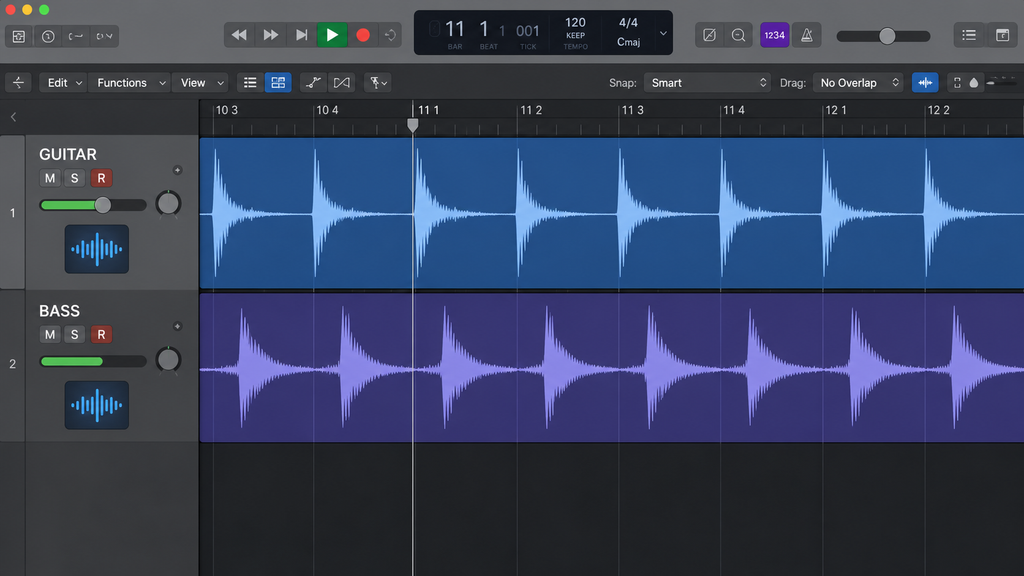
When I was working with Tony Bennett, we did the Mike Douglas show back in the 80’s. Ray Brown (the great bassist) was in the house band on the show, and after Tony’s soundcheck pulled me aside, asking if he could share some advice. “Sure, Mr Brown!” (He was one of my heroes.) He looked me in the eye, held up his left hand, and said “time is here,” glancing toward his left hand. It took 30 years for the meaning of that wisdom to become apparent to me.
Young rhythm sections endlessly replay the classic, circular argument: “You’re rushing!” “No, you’re dragging!” so mercilessly exemplified in the movie “Whiplash” (which, after seeing a preview, I boycotted). Pulse is innate, making these accusations deeply undermining. Ironically, drummers often get the blame—sometimes developing an “enforcer” mentality—when the issue often originates with the bass or rhythm guitar.
Drums are mechanically straightforward: a simple, vertical bounce. Bassists and rhythm guitarists, however, must navigate complex physical terrain, moving across strings and up and down the neck while attempting to lock in a pulse. But physical complexity alone isn’t the root issue.
The real problem lies in where the player perceives the beat:
- Is it at the initial point of physical contact (the attack of the pick/right hand)?
- Or is it when the sound actually blooms into the space?
The True Pulse Anchor
Generating a note on a plucked or strummed instrument requires a physical sequence. The note is stopped with the fretting hand, but the initial right-hand attack is just the catalyst. Right after that stroke, the sound blooms—delivering the acoustic “hump” where the fundamental frequency blooms.
That fundamental doesn’t just travel to the audience; it manifests physically:
- The Left Hand: The fretting fingertips immediately feel the string’s resonant vibration—the physical manifestation of the auditory event.
- “Belly Listening”: The low-frequency bloom hits the body directly, registering in the belly as a visceral signal.
Where there is spatial excursion of motion, there is an opportunity for delay—especially if your mind anchors the beat to the initial touch or stroke. Ray Brown’s wisdom points directly to shifting your mental focus away from the physical effort of playing to the feeling of the sound you’re making.
When you anchor your intention directly to the tactile vibration in your left hand and the visceral response in your belly, you bridge the gap between touch and sound. Shifting to this sensory awareness eliminates the lag that destabilizes a band, allowing the entire rhythm section to lock into an effortless, shared groove.
Leave a Reply