Most people have sedentary occupations and sedentary lives, often without being aware of the consequences. People sit at desks, then sit in the car to go home, then sit in front of the TV after dinner. Many people include exercise somewhere in their schedules, but over time, it’s usually not enough.
The Problem with Sitting
Exercise can help delay the pain and disability we associate with aging. But for most people, sitting is what they do for most of their waking lives, and a few hours of exercise a week may not be enough to maintain physical health and function against all those hours spent sitting.
Eventually, things start to happen:
- Muscles become weak or underused.
- Range of motion decreases.
- Posture changes.
- Pain begins — back, hips, knees, neck, shoulders.
- Balance becomes an issue.
- Mobility is lost.
- Disability begins.
I had minor back and hip issues for years, peaking about 10 years ago when I finally sought medical help for lower-back pain. I was given an epidural injection and sent to a physical therapist, who turned out to be useless. Then I joined a gym and kept going until the pandemic hit.
The Road to Recovery
More recently, with pain returning, I saw a very good physical therapist at Mass General. I came away with the familiar protocol: exercise bands, a list of exercises, three sets of ten, twice a day — essentially, for the rest of my life.
This time, though, I learned something important. I began to understand muscular imbalances: how one part of a muscle pair can become weak or underused while another compensates; how muscles can effectively drop out of habitual movement patterns; why people even use terms like “glute amnesia.” The bands and exercises helped me become aware of muscles I hadn’t been using effectively, and I began exploring ways to keep using them during posture and walking — something we already do a lot. For various reasons, we generally get around 10,000 steps a day.
But I became interested in whether I could load these muscles without doing “exercises.” While exploring ways to put isometric load on some of these formerly underused muscles, I started exploring Tai Chi, which I found very useful. Then one day, while leaning backward with bent knees during Tai Chi-like movement, I stumbled onto something different.
Dynamic Isometrics
What is it about Tai Chi that made it become a core practice in Chinese society and increasingly popular with western fitness devotees? Answer: Dynamic Isometrics. We can define Dynamic Isometrics as isometric exercise that modulates to adjacent or related muscle groups.
Muscles work in opposing pairs. Isometrics invokes pair members to work against each other, or against body weight, to put load on a certain muscle or muscle pair.
Instead of keeping the trunk erect, as is customary in Tai Chi, I leaned backward with bent knees and began moving through different positions — shifting my weight, changing the depth of the bend, extending and rotating the pelvis and trunk, moving the arms, exploring the limits of balance. It was somewhere between Tai Chi and a Limbo dance.
Something interesting was happening. The movement was continuously putting load on weak muscles while taking other muscles and connective tissues through ranges they weren’t accustomed to. Changing position changed the load; moving farther changed it again; shifting my weight changed it again. It isn’t one exercise, but rather a continuously changing range of them.
It felt oddly satisfying. You may know the expression “good pain.” That’s what I was feeling. More surprisingly, I began to crave it. Every time I got up after sitting, I wanted to move this way. Standing around the kitchen became an opportunity. Waiting for something became an opportunity. First thing in the morning, my body wanted it. It wasn’t another exercise program I had to remember to do; it was becoming part of the way I moved.
Limbo-Chi – the Antidote
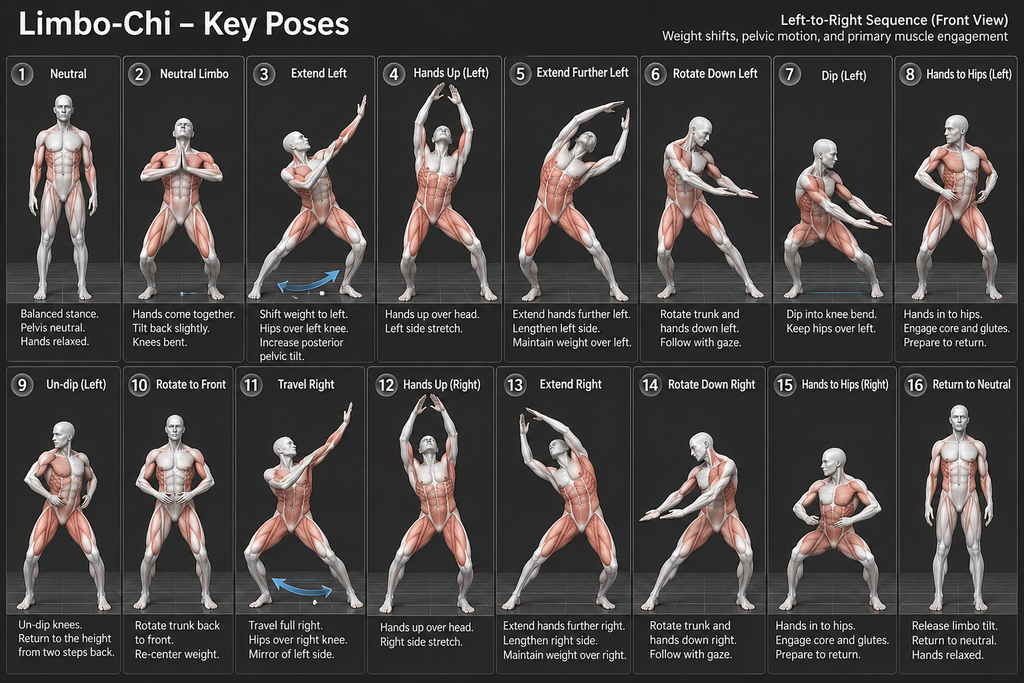
Continuous Load Through Variable Movement
That’s the principle I eventually realized I’d stumbled upon. Rather than isolating a muscle, doing ten repetitions, resting, and moving to the next exercise, I could maintain muscular load while continuously changing the position of my body: a little farther back, a little lower, weight over the left foot, then the right, rotate, reach, extend, hold, move through it.
Each change alters which muscles are carrying the load, which are lengthening, which are stabilizing, and what the balance system has to do to keep the whole structure upright. The exercise isn’t any one position; the exercise is the excursion through them. Because it requires no equipment, no gym and no scheduled workout, it can also occupy moments that would otherwise contain no meaningful movement at all. In that sense, I’ve come to think of Limbo-Chi as un-sitting.
Rolling Back the Clock
Before I started doing this, I had reached the point where I was becoming slightly hesitant about stepping onto a step stool. I was experiencing morning stiffness, and certain movements had begun to feel like things I should approach carefully. Those are little changes, and that’s precisely why they’re dangerous: you don’t necessarily notice the movements disappearing from your life; you just stop making them. Every day a little more is lost.
Since beginning Limbo-Chi, I’ve experienced the opposite.
- My balance has improved.
- My hips move more freely.
- Morning stiffness and pain have diminished dramatically.
- Movements that had begun to require thought don’t require thought anymore.
- I feel energetic and flexible in ways I haven’t in years.
It feels as if years have been erased.
I think there’s an important distinction here. Aging can mean many different things, and our bodies obviously change biologically with age. But the effects of decades of sitting also accumulate with age, making it very easy to confuse the consequences of disuse with aging itself. They aren’t necessarily the same thing.
Strength can improve, balance can improve, mobility and range of motion can improve, muscles that haven’t been doing their share can be recruited again, and movement that has gradually disappeared can be rediscovered. To the extent that what we experience as “getting old” consists of progressive stiffness, weakness, poor balance and loss of mobility, some of that clock can be rolled backward.
The challenge is finding a way to make the necessary movement part of life rather than another obligation added to it. For me, Limbo-Chi has become exactly that: not a workout I have to make myself do, but a movement practice my body actually asks for.
Leave a Reply